hink back to your middle school or high school math classroom. Do you remember rows of desks and worksheets you completed on your own? That was my experience, and it’s one reason I love using math partner activities today.
Self-checking math partner puzzles give students a reason to solve independently and compare their thinking. Each partner works a different problem that should have the same answer. When their answers don’t match, they can compare their work, find the mistake, and try again. It’s a simple way to add collaboration and meaningful practice to a math lesson.
Why Use Math Partner Activities?
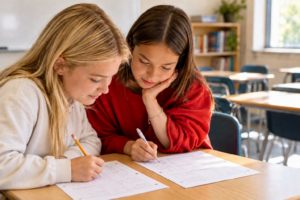
Partner work can give students more than a chance to sit together. When each student has a different problem, both partners have a job to do. They solve their own problems first, then explain their thinking and check their answers together.
I especially like hearing what happens when answers don’t match. Instead of immediately asking me which answer is correct, students can look back at their steps and ask, “Where did we get different results?” That conversation can reveal a mistake or a misunderstanding that might have gone unnoticed during independent practice.
Math partner activities can also help students:
-
Practice a skill while talking through their reasoning
-
See another way to approach a problem
-
Catch and correct errors
-
Build confidence explaining their work
How Do Self-Checking Math Partner Puzzles Work?
Partners receive different sets of problems. Each student solves their own problem, but the corresponding problems should have the same answer.
After solving, partners compare answers. If the answers differ, they revisit their work together before moving on. Once they agree on an answer, each student finds it in their own answer bank and records the letter beside it. As they complete the activity, they use the letters to unscramble a ten-letter compound word.
The matching answers provide a quick check, while the mystery word gives partners another goal to work toward. If they get stuck, the riddle clues can help them figure out the word.
How I Use These Puzzles in Class
I introduce the activity by showing students one pair of problems and explaining that the problems look different but should lead to the same answer. Then I have partners follow a simple routine:
-
Solve your own problem. Each student does the math before comparing answers.
-
Compare answers. Partners check whether their results match.
-
Discuss any mismatch. They look through their steps, correct errors, and try again.
-
Find the letters. Each student uses their own answer bank to find the letter associated with the answer.
-
Solve the word puzzle. Partners use their collected letters and the clues to figure out the compound word.
As students work, I can listen to their conversations and help when they need a prompt. I might ask, “Which step gave you different results?” or “How could you check that answer?” Their work tells me which skills may need another example or a quick review.
Find a Puzzle for Your Class
I’ve created self-checking partner puzzles for several grade levels and math topics:
-
6th Grade Collaborative Self Checking Partner Puzzle Activities Bundle
-
7th Grade Collaborative Self Checking Partner Puzzle Activities Bundle
-
Algebra 1 Collaborative Self Checking Partner Puzzle Activities Bundle
Try a free multi-step equations partner puzzle to see how the format works with your students.
Fill out the form below, and I’ll send it to your inbox!